
Care Home Fire Risk Assessment: What Good Looks Like
- Posted by Sam Yates
- On September 20, 2026
- 0 Comments
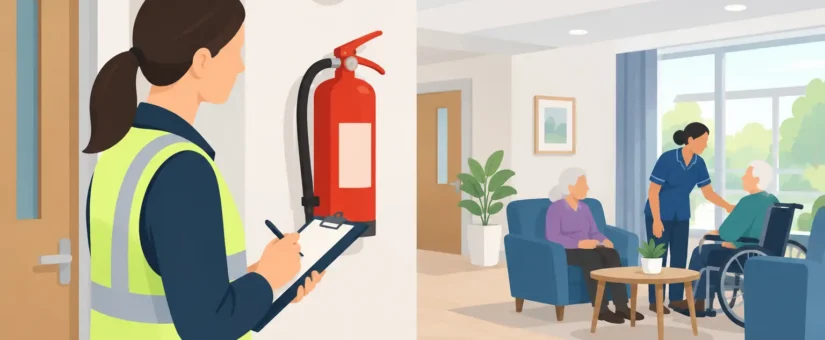
A care home fire risk assessment is not a paper exercise completed to satisfy an inspection. It must reflect the reality of a building where many residents may be asleep, unable to self-evacuate, living with dementia, using mobility equipment or reliant on staff for immediate support. A missed defect in a fire door, an unclear evacuation plan or insufficient night staffing can have serious consequences.
For operators, directors, trustees and facilities teams, the assessment is the foundation for a safe, workable fire strategy. It identifies what could cause a fire, who may be at risk, whether existing precautions are adequate and what must be improved. Just as importantly, it creates clear evidence of the decisions made to protect residents, staff and visitors.
Why care homes need a specialist approach
Care homes are among the more demanding premises to assess because fire safety cannot be separated from care delivery. Residents may have reduced mobility, impaired hearing or sight, cognitive impairment, medical dependencies, or anxiety that affects their response to alarms and instructions. The assessor must consider the building, its management and the people who occupy it together.
In England and Wales, the Regulatory Reform (Fire Safety) Order 2005 places duties on the responsible person to take general fire precautions and carry out a suitable and sufficient fire risk assessment. In a care setting, this cannot be based on an assumption that everyone will leave immediately through the nearest exit. The assessment must examine whether the chosen evacuation strategy is realistic at all times, including overnight, at weekends and during periods of reduced staffing.
A generic assessment may identify extinguishers, escape routes and alarms. A competent care home assessment goes further. It asks whether compartmentation supports progressive horizontal evacuation, whether staff can move residents through fire-resisting barriers safely, whether fire doors close and latch reliably, and whether personal evacuation arrangements are understood in practice.
What a care home fire risk assessment should examine
A formal assessment should follow a recognised methodology, such as PAS 79 principles, while being tailored to the home’s layout and resident profile. The site visit needs to be thorough enough to test the practical controls that management relies upon every day.
The people at risk
The starting point is not the building plan. It is the residents. An assessor should consider how residents receive an alarm, how they are assisted, where they can be moved to and what support is available on each shift. This includes residents who use wheelchairs, hoists, oxygen, specialist mattresses or other equipment that may affect movement or introduce additional ignition and fuel considerations.
Personal Emergency Evacuation Plans can be relevant, but they must work alongside the overall evacuation strategy rather than becoming isolated documents held in care files. Staff need access to accurate information while respecting confidentiality, and arrangements must be reviewed when a resident’s needs change.
Visitors, agency workers, contractors and lone workers must also be considered. A home may be familiar to permanent staff, but a visiting professional or new night worker may not know the compartment boundaries, assembly procedures or location of emergency equipment.
Ignition sources, fuel and oxygen
Care environments contain familiar fire hazards: cooking, smoking materials, electrical equipment, laundry appliances, charging leads, portable heaters and maintenance works. The assessment should identify both the hazards and the management controls in place.
Particular attention may be needed where residents smoke, use e-cigarettes, receive oxygen therapy or have equipment charging in bedrooms and communal areas. A blanket ban is not always a practical or appropriate solution. The safer answer may involve supervised smoking arrangements, fire-retardant materials, suitable receptacles, charging controls, staff instruction and proportionate monitoring. The right measures depend on individual circumstances and the home’s risk profile.
Laundry rooms and kitchens also deserve close scrutiny. Good housekeeping, appliance maintenance, extraction cleaning and controls around unattended cooking can significantly reduce risk. Temporary arrangements matter too. A corridor used to store deliveries, laundry cages or mobility aids can quickly compromise an escape route.
Means of warning and escape
The fire alarm system must be suitable for the premises and the evacuation approach. An alarm that gives early warning is only useful if it prompts a response that staff can carry out safely. The assessment should consider detector coverage, alarm audibility, visual warning where required, call points, testing records, servicing and the procedure for false alarms.
Escape routes should be protected, adequately lit and kept clear. In a care home, this includes checking whether bedroom corridors lead to safe compartments, whether doors are held open appropriately and whether final exits can be used by staff supporting residents with mobility needs.
Fire doors are frequently a decisive line of protection. They should be correctly fitted, close fully into the frame, latch properly, have suitable seals and remain free from wedges or damage. Doors fitted with approved hold-open devices may support day-to-day care and accessibility, but they must release on alarm and be maintained. Convenience cannot override the need to contain smoke and fire.
Compartmentation and progressive horizontal evacuation
Many care homes rely on progressive horizontal evacuation rather than immediate evacuation of the whole building. Residents are moved first into an adjoining fire-resisting compartment on the same level, buying time and reducing the need to use stairs in the earliest stage of an incident.
This strategy depends on the integrity of walls, ceilings, service penetrations and fire doors. Unsealed cable routes, damaged ceiling tiles, poorly maintained risers or unprotected service openings can undermine the separation that the strategy assumes is present. An assessment should therefore consider visible evidence of compartmentation defects and recommend further inspection where concealed construction needs specialist investigation.
The strategy must also be tested against staffing levels. If two staff members are expected to relocate several dependent residents while one remains with another resident receiving care, the plan may not be achievable. Fire safety procedures should reflect actual staffing, not ideal staffing.
Management measures are as important as equipment
Even a well-designed building can be made unsafe by weak management arrangements. A care home fire risk assessment should review induction, refresher training, fire drills, alarm testing, emergency lighting checks, fire-door inspections, maintenance records and the process for reporting defects.
Training must be relevant to role and shift pattern. Staff should know how to raise the alarm, call the fire and rescue service, use the evacuation equipment provided and move residents in accordance with the home’s plan. They should also understand when not to attempt firefighting. Extinguishers are primarily intended to support escape and deal with very small, safe-to-tackle fires, not to place staff in danger.
Drills should be planned sensitively. A full alarm activation may distress some residents, particularly those living with dementia, but that is not a reason to avoid exercising procedures altogether. Table-top exercises, staff scenarios and carefully managed practical drills can help test decision-making without causing unnecessary upset. Records should show what was learned and what changed as a result.
Common gaps that require prompt action
Care providers often know that improvements are needed but struggle to prioritise them alongside operational demands. A clear report should distinguish between urgent life-safety issues and longer-term improvements, with practical recommendations and appropriate timescales.
Issues that commonly require attention include:
- fire doors that do not close, latch or provide adequate smoke protection;
- blocked corridors, stairways or final exits;
- insufficient evidence of alarm, emergency lighting or extinguisher maintenance;
- inadequate staff understanding of progressive horizontal evacuation;
- a mismatch between resident dependency levels, evacuation plans and night staffing;
- unsealed service penetrations that compromise compartment walls and floors.
Not every finding requires the same response. A defective fire door on a sleeping accommodation corridor may need urgent repair, while an improvement to record-keeping may be planned and monitored. The assessment should explain the reason for each priority, enabling management to make informed decisions and demonstrate due diligence.
When should the assessment be reviewed?
The fire risk assessment is a live management document. It should be reviewed regularly and whenever there is reason to believe it is no longer valid. That may follow alterations to the building, a change in use, a significant shift in resident dependency, an incident, a near miss, changes to staffing arrangements or the installation of new equipment.
Many providers choose periodic professional reassessment to obtain an independent view and keep their documentation current for insurers, commissioners, lenders and enforcement authorities. This is particularly valuable before a property transaction, a regulatory inspection, refurbishment works or the opening of a new service.
The written report should be accessible to the people who need to act on it. Digital reporting and secure cloud access can make it easier to share actions with senior management, maintenance contractors and site teams, while keeping a reliable audit trail of completed works.
Choosing competent assessment support
The responsible person retains responsibility for fire safety, even when appointing an external assessor. Choosing competence therefore matters. Look for an assessor who understands care environments, can explain findings clearly, carries appropriate insurance and produces a detailed, actionable report rather than a generic checklist.
Firelux supports care providers across London and the South East with thorough, documented assessments, flexible appointment arrangements and practical follow-up advice. Where an assessment identifies a need for improvements, a clear action plan helps the home address risk without losing sight of resident care and day-to-day operations.
The most useful assessment is one your team can act on confidently. If a recommendation cannot be understood, scheduled, assigned and checked, it will not make residents safer. Start with an accurate picture of the premises, keep the evacuation strategy aligned with the people in your care, and make sure every identified action has an owner and a realistic completion date.


0 Comments