
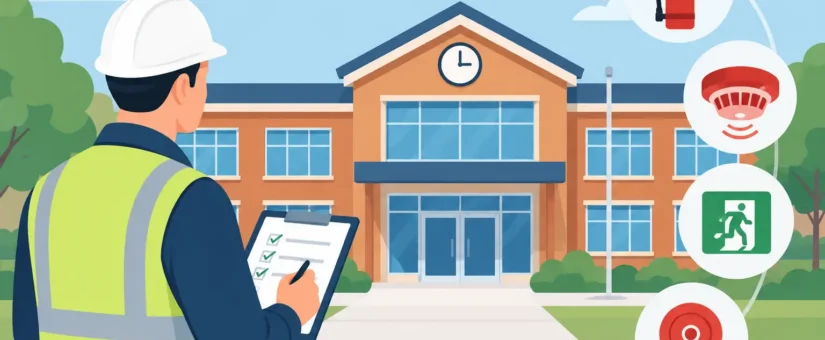
What a Fire Risk Assessment for Schools Covers
- Posted by Sam Yates
- On September 19, 2026
- 0 Comments
A school day can change pace in seconds. Corridors fill between lessons, visitors sign in at reception, a hall may be used by the community after hours, and some pupils need tailored support to evacuate safely. A fire risk assessment for schools must account for that real operating environment, not simply record whether extinguishers are on the wall.
For headteachers, trust estates teams, governors and local authority property managers, the assessment is a practical compliance document. It should identify fire hazards, people at risk and the measures needed to reduce the chance of fire and support a safe escape. Just as importantly, it should give those responsible for the premises a clear, prioritised route from findings to action.
Who is responsible for school fire safety?
Under the Regulatory Reform (Fire Safety) Order 2005, the responsible person must take general fire precautions so far as is reasonably practicable. In a school, responsibility will depend on how the premises are controlled. It may sit with the employer, academy trust, local authority, governing body, proprietor or another person with control of all or part of the building.
The title held by an individual is less important than clarity over who has authority to commission work, manage maintenance, implement procedures and keep records. Where responsibilities are split – for example, between a school, a trust and a landlord – those parties must co-operate and co-ordinate their arrangements.
A suitable and sufficient assessment should be carried out by a competent person. It must be recorded where five or more people are employed, and the significant findings and fire-safety measures should be documented. In practice, a formal written report is essential for schools of any size: it provides an auditable basis for management decisions, insurer queries and any interaction with enforcing authorities.
What a fire risk assessment for schools examines
A competent assessor will inspect the premises and consider how the school functions day to day. The scope should include the building fabric, installed fire precautions, management arrangements and the people who may need assistance. A PAS 79-aligned methodology helps ensure the process is systematic and the resulting report is clear enough to act upon.
Sources of ignition, fuel and oxygen
The assessment considers foreseeable ignition sources such as cooking equipment, science laboratories, electrical installations, portable heaters, workshops and charging areas. It also looks at combustible materials and how they are controlled. Store cupboards packed with paper, scenery in a drama space, cleaning supplies, waste awaiting collection and displays in circulation areas can all affect fire development and escape conditions.
This does not mean a school must remove every display or restrict normal teaching. The question is whether materials are sensibly located, ignition sources are managed and any risk is proportionate to the setting. A well-run art department, for instance, needs practical storage controls rather than a generic instruction that prevents teaching activity.
Means of escape and fire separation
Escape routes must remain available, suitable and adequately protected. The assessor will review corridors, stairways, final exits, emergency lighting, signage and the arrangements for opening doors in an emergency. Obstructions are a recurring concern in busy schools, particularly where furniture, deliveries, recycling or pupil work migrates into escape routes over time.
Fire doors require particular attention. A door that is wedged open, damaged, poorly fitted or prevented from closing can allow smoke and fire to spread beyond its intended compartment. The assessment should identify visible shortcomings and establish whether a more detailed door inspection or remedial works are required.
Larger or altered sites may have complex compartmentation, including voids, service penetrations and extensions constructed at different times. Where the available evidence is incomplete, the report should say so plainly and recommend proportionate further investigation. Assumptions are not a substitute for evidence where fire separation is critical.
Detection, warning and firefighting equipment
Fire alarm and detection arrangements should suit the building, occupancy and management procedures. The assessment considers alarm coverage, call points, audibility, testing, maintenance records and the method used to summon the fire and rescue service. It should also consider whether alarm signals can be heard in noisy rooms, outdoor areas or spaces used by people with hearing impairments.
Portable extinguishers, fire blankets and other equipment need to be appropriately selected, positioned and maintained. Staff should understand their role, but no member of staff should be expected to tackle a fire where it is unsafe to do so. Evacuation remains the priority.
People at greater risk
Schools are not uniform workplaces. Pupils may be very young, unfamiliar with the building, temporarily injured, neurodivergent, mobility-impaired or unable to understand an alarm without support. Visitors, contractors, volunteers and lettings users may also have little knowledge of escape routes.
The assessment should examine how staff will assist these groups, including personal emergency evacuation plans where appropriate. A plan only works when it has named responsibilities, suitable equipment where needed, staff training and cover for absence. It must also be tested without creating undue distress for the pupil concerned.
Management arrangements are where compliance succeeds or fails
Physical measures matter, but a compliant building can become unsafe if procedures are not followed. The assessment should review fire drills, staff induction, visitor management, out-of-hours use, contractor controls, defect reporting and routine checks.
Many schools have multiple occupancies across a week. Breakfast clubs, after-school activities, parents’ events and external hirers can alter both the number of people on site and the staff available to manage an evacuation. Lettings agreements should make fire-safety responsibilities explicit. Hirers need clear instructions, access to suitable exits and a reliable way to raise the alarm.
Records are equally important. Regular alarm tests, emergency lighting checks, fire-door observations, evacuation drills and servicing certificates demonstrate that measures are being maintained. A digital report and cloud-accessible supporting documentation can make this far easier for an estates team, particularly where several schools are managed across a trust.
When should a school review its assessment?
A fire risk assessment is a live document, not a report to file away until an inspection is due. It should be reviewed regularly and whenever there is reason to believe it is no longer valid. There is no single statutory interval that suits every school, although an annual review is commonly adopted as sound management practice.
A review is especially necessary after significant changes, such as building works, a revised room layout, changes to occupancy, new equipment, altered evacuation arrangements, a fire incident or a near miss. A material change in the needs of a pupil or staff member can also require procedures to be reconsidered.
Refurbishment deserves early attention. Fire safety should be considered during design and planning, rather than after contractors have left site. Changes to partitions, doors, ceilings, services or the use of a room may affect detection, escape routes and compartmentation. Early advice is usually less disruptive and more cost-effective than retrospective corrections.
Turning findings into workable action
The value of an assessment lies in the quality of its recommendations. A useful report distinguishes urgent life-safety concerns from improvements that can be scheduled, explains why each action is required and identifies the relevant location. Vague wording such as “improve fire safety” leaves a school team with little to manage.
Actions should be assigned to an owner and tracked to completion. Some matters can be resolved promptly through better housekeeping, staff briefing or replacing signage. Others, such as alarm upgrades, fire-door repairs or intrusive compartmentation surveys, require budgeting, specification and competent contractors. The correct response depends on the risk, not on choosing the quickest or lowest-cost option.
Firelux provides documented, insurance-compliant assessments with clear digital reporting and practical follow-up support. For occupied education premises, flexible inspection arrangements can help minimise disruption to teaching while ensuring the assessor has enough access to inspect the areas that matter.
The most useful question for a school leadership team is not whether a report is in date. It is whether staff could act confidently if the alarm sounded now – with every pupil, visitor and after-school user accounted for. That is the standard an effective assessment should help the school meet.

0 Comments