
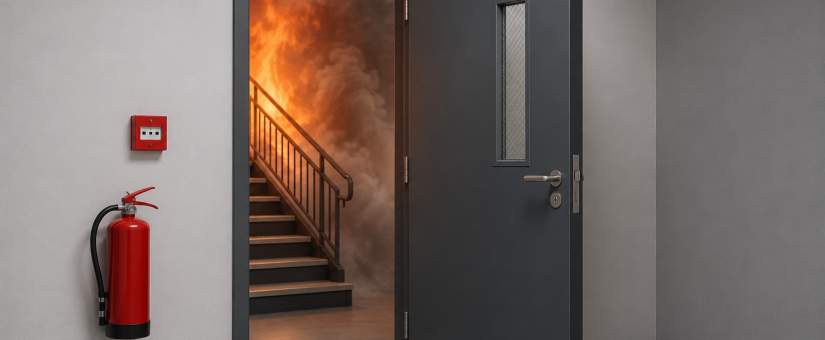
Fire Doors: The First Line of Defence Against Fire Spread
- Posted by Sam Yates
- On June 25, 2026
- 0 Comments
- Building Regulations, Building Safety, Commercial Fire Safety, Emergency Evacuation, FD30 Doors, FD60 Doors, fire compartmentation, Fire Door Inspections, Fire Door Installation, Fire Door Maintenance, Fire Doors, Fire Protection, Fire Risk Assessment, Fire Safety, Fire Safety Compliance, Fire Safety Inspections, passive fire protection, Property Safety, Smoke Protection, Workplace Fire Safety
When a fire breaks out, every second matters. While fire alarms, extinguishers, and sprinkler systems all play vital roles in protecting lives and property, one of the most effective passive fire protection measures is often overlooked—fire doors. Not only do they slow the spread of fire and smoke, but they also protect escape routes, giving occupants valuable time to evacuate safely. Consequently, understanding their purpose and ensuring they are correctly installed and maintained can make a life-saving difference.
What Are Fire Doors?
Fire doors are specially engineered doors designed to resist the passage of fire and smoke for a specified period, typically 30 minutes (FD30) or 60 minutes (FD60). Unlike standard doors, they are constructed using fire-resistant materials and fitted with specialist hardware that enables them to perform effectively during a fire.
A complete fire door assembly includes:
- Fire-resistant door leaf
- Fire-rated frame
- Intumescent seals
- Smoke seals (where required)
- Fire-rated hinges
- Self-closing device
- Approved locks, latches, and ironmongery
Together, these components create a complete fire-resistant barrier. Therefore, if even one element is missing or damaged, the overall effectiveness of the fire door may be compromised.
Why Are Fire Doors So Important?
Protecting Escape Routes
One of the primary functions of a fire door is to create protected corridors and stairwells that allow occupants to evacuate safely. By slowing the spread of flames and smoke, fire doors help keep these routes clear. As a result, people have more time to leave the building safely before conditions become dangerous.
Limiting Fire Damage
Fire compartmentation is one of the most effective methods of controlling fire spread. Essentially, fire doors divide buildings into separate fire-resistant compartments, helping to contain a fire within its area of origin. Consequently, this limits damage to the rest of the property and can significantly reduce repair costs.
Saving Lives
Although flames present an obvious danger, smoke inhalation is responsible for many fire-related fatalities. For this reason, fire doors fitted with smoke seals play a critical role in restricting the movement of toxic smoke. Furthermore, they provide occupants with additional time to escape while allowing emergency services greater control of the incident.
Supporting Firefighters
Fire doors not only protect building occupants but also assist emergency responders. By containing the fire within one section of the building, firefighters can tackle the blaze more safely and effectively. As a result, risks to both emergency personnel and occupants are significantly reduced.
Common Locations for Fire Doors
Fire doors are commonly installed in:
- Apartment block communal areas
- Office buildings
- Schools and universities
- Hospitals and healthcare facilities
- Hotels
- Industrial premises
- Plant rooms and service cupboards
- Stairwells and escape routes
Depending on the building’s design and use, additional fire doors may also be required. Accordingly, their placement is determined during the building’s fire risk assessment and must comply with current fire safety regulations.
The Importance of Regular Fire Door Inspections
A fire door is only effective if it remains in good working condition. However, everyday use, accidental damage, poor installation, or unauthorised alterations can all reduce its ability to perform during a fire.
Routine inspections should check:
- The door closes fully without obstruction.
- Intumescent and smoke seals are intact.
- Hinges are secure.
- Glazing is fire-rated and undamaged.
- There are no excessive gaps around the door.
- The self-closing device operates correctly.
- The door has not been modified without approval.
By carrying out regular inspections, building owners can identify defects before they become serious safety issues. Ultimately, even seemingly minor faults can prevent a fire door from performing as intended during an emergency.
Common Fire Door Problems
Some of the most frequently identified issues include:
- Damaged or missing seals
- Faulty self-closing mechanisms
- Excessive gaps around the frame
- Damaged door leaves
- Incorrect replacement hardware
- Doors wedged open
- Poor installation
Although these issues may appear minor, they can significantly reduce the fire resistance of the door. Therefore, prompt repairs and ongoing maintenance are essential.
Legal Responsibilities
Building owners, landlords, facilities managers, and responsible persons all have legal duties to ensure fire safety measures are maintained.
In addition, fire doors should be inspected regularly as part of an ongoing fire safety management programme. Maintaining accurate inspection records and carrying out prompt repairs not only helps demonstrate compliance but alsoprotects building occupants and reduces potential liability.
Fire Doors Are Only Effective When Closed
One of the most common mistakes is wedging fire doors open for convenience. Unfortunately, a fire door can only perform its intended function when it is fully closed. Unless it is connected to an approved automatic release system linked to the fire alarm, it should never be held open using wedges or other improvised methods.
Final Thoughts
Fire doors are one of the most important passive fire protection measures in any building. Although they may appear to be ordinary doors, they perform an extraordinary role in protecting lives, preserving escape routes, limiting fire damage, and supporting emergency response efforts.
Ultimately, regular inspections, correct maintenance, and professional installation ensure that fire doors remain ready to perform when they are needed most. By investing in fire door safety, organisations are not simply meeting legal requirements—they are protecting people, property, and peace of mind.
Need expert fire door inspections or maintenance? Contact our experienced team today to ensure your fire doors remain fully compliant and ready to protect your building when it matters most.

0 Comments