
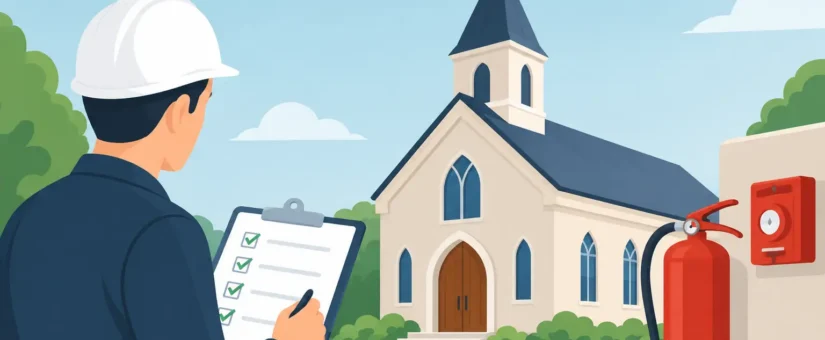
Church Fire Risk Assessment Requirements Explained
- Posted by Sam Yates
- On September 21, 2026
- 0 Comments
A Sunday service can bring together a full congregation, volunteers, visiting families and people who may be unfamiliar with the building. Add candles, ageing electrical systems, timber roofs, community groups and occasional fundraising events, and a church presents a fire-safety profile that deserves careful attention. Meeting church fire risk assessment requirements is not simply a paperwork exercise. It is the process that helps protect people, preserve a valued building and demonstrate that the organisation has taken its legal duties seriously.
For many churches, the practical challenge is that the premises are used differently throughout the week. A quiet weekday service, a packed Christmas concert, a toddlers’ group in the hall and a private hire all create different fire risks and evacuation demands. The assessment must reflect how the church actually operates, not how it appears during a brief inspection.
Do churches need a fire risk assessment?
In most cases, yes. The Regulatory Reform (Fire Safety) Order 2005 applies to virtually all non-domestic premises in England and Wales, including places of worship and associated spaces such as church halls, offices, kitchens, meeting rooms and storage areas. The legislation requires the responsible person to make a suitable and sufficient assessment of the risk from fire and to put appropriate general fire precautions in place.
The responsible person is usually the individual or organisation with control of the premises. Depending on the church’s governance, this may be the trustees, churchwardens, PCC, minister, charity trustees or a managing body. More than one party can have duties where control is shared, such as a hall let to an independent nursery or community organisation. Responsibilities should be clear rather than assumed.
A church building’s historic or listed status does not remove these obligations. It may affect the choice and installation of fire-safety measures, particularly where fabric, fittings or escape routes are protected, but it does not reduce the duty to safeguard occupants. Early discussion between the church, a competent fire-risk assessor and relevant heritage advisers can help identify proportionate solutions.
When findings must be recorded
A fire risk assessment must always be carried out. Its significant findings and the measures taken or proposed must be recorded where the church employs five or more people, holds a licence, is subject to an alterations notice, or has been served with an enforcement notice. In practice, a clear written report is strongly advisable for every church. It provides evidence for trustees, insurers, regulators and future office holders, and prevents essential information being lost when volunteers change.
What a suitable church fire risk assessment covers
A compliant assessment considers three connected questions: what could start a fire, who may be at risk, and whether the existing precautions are adequate. A PAS 79-aligned assessment provides a disciplined framework for documenting those decisions and creating a practical action plan.
Fire hazards and ignition sources
Churches often contain a mix of modern services and older building elements. The assessor will consider electrical intake rooms, consumer units, portable heaters, lighting, kitchen equipment, boilers, battery charging, contractors’ works and any hot works such as welding or roof repairs. Portable appliance use should be managed sensibly, especially where volunteers bring equipment into the building.
Open flames require particular attention. Candles, incense, charcoal burners and votive stands may be integral to worship, but they need controlled locations, suitable non-combustible holders, supervision and clear separation from combustible furnishings, decorations and robes. The point is not to prohibit normal worship unnecessarily. It is to make sure practices are properly controlled for the setting and level of attendance.
Fuel sources can be less obvious. Stored scenery, paper records, cleaning supplies, stacked chairs, Christmas decorations, flower displays and accumulated items in vestries or roof spaces can increase fire growth and obstruct access. Good housekeeping is one of the most cost-effective controls, particularly in corridors, stairways and escape routes.
People at risk and evacuation arrangements
The assessment must account for everyone who could be present, including regular worshippers, children, older people, visitors, volunteers, staff, contractors and people with mobility, sight, hearing or cognitive impairments. A congregation may know the building well, while guests attending a wedding, funeral or concert may not know the exits at all.
Escape routes must be available, clear, adequately signed where appropriate, and capable of being used safely. The number and location of exits depend on occupancy, layout and travel distance. A small weekday gathering and a full seasonal service may need different stewarding arrangements. Where doors are kept locked for security, the method of opening must not delay evacuation.
Churches should also consider how assistance will be provided without creating an unsafe reliance on one named person. Personal Emergency Evacuation Plans may be appropriate for employees or regular building users with known needs. For larger public events, trained stewards, a clear evacuation announcement and an agreed assembly point can be more practical.
Detection, warning and firefighting equipment
Whether a church needs an automatic fire alarm system depends on the size, complexity and use of the premises. A simple, open-plan church with good visibility may require a different solution from a multi-room church centre, building with sleeping accommodation, or premises used for unsupervised activities. The assessment should explain why the chosen alarm and warning arrangements are suitable.
Fire extinguishers, fire blankets and emergency lighting must be correctly selected, positioned, maintained and supported by appropriate staff or volunteer instruction. Extinguishers are for tackling only very small fires where it is safe to do so. Evacuation remains the priority.
Fire doors, compartment walls and protected stairways can be especially significant in churches with halls, offices or upper floors. Wedging open a fire door for convenience can defeat a key life-safety measure. Conversely, specifying intrusive changes to a historic door without assessing alternatives can create avoidable heritage and cost issues. Competent advice helps balance both considerations.
When should a church review its assessment?
There is no fixed statutory annual expiry date for every fire risk assessment, but the responsible person must keep it under review. An annual review is widely regarded as sensible good practice, even where no material changes are identified. The document should be formally revisited sooner after a change that could affect fire safety.
Examples include building works, a change in occupancy or use, installation of new electrical or heating equipment, a new hire arrangement, an event with substantially higher attendance, a fire or near miss, or changes to the people using the premises. A church that starts hosting a nursery, food bank or evening community sessions should not rely on an assessment prepared solely around Sunday worship.
The same principle applies to an older report with actions that were never completed. The assessment is only useful when findings are translated into managed improvements. Trustees should assign actions, set realistic target dates, retain evidence of completion and revisit outstanding items at meetings.
Common gaps that create avoidable risk
Many deficiencies arise not from major construction faults but from everyday drift. Escape routes become temporary storage areas, alarm tests are not logged, emergency lighting checks are missed, or fire doors are altered during maintenance. In volunteer-led settings, responsibilities can become unclear after a change of personnel.
Church halls can also be overlooked. If a hall is hired out, the responsible person still needs an effective system for communicating fire procedures, checking exits and controlling hazardous activities. Hiring agreements should make clear what users may and may not do, including restrictions on cooking, decorations, electrical equipment, naked flames and overnight use where relevant.
A professional assessment should identify priorities in plain terms. Not every recommendation has the same urgency or cost. Some actions may be immediate life-safety issues, while others can be planned alongside maintenance or refurbishment. Clear risk ratings and practical recommendations help trustees make defensible decisions and manage budgets responsibly.
Choosing competent support
The Fire Safety Order does not require every church to appoint an external assessor, but it does require the responsible person to appoint competent persons where needed. Competence means more than completing a checklist. It involves understanding fire behaviour, relevant legislation, building construction, means of escape, fire-protection systems and the specific use of the premises.
For a complex, historic, multi-use or heavily occupied church, independent support is often the most reliable route. Look for an assessor who can inspect thoroughly, explain recommendations clearly, provide an exhaustive digital report and remain available for questions after issue. Insurer-facing, well-documented assessments are particularly valuable when arranging cover, responding to an enquiry or progressing a property matter.
Firelux supports churches and other community premises across London and the South East with thorough, insured assessments, responsive scheduling and practical follow-up advice. This can be particularly helpful where an inspection must be arranged around services, tenants or urgent compliance requirements.
A church’s fire precautions should make people feel protected without disrupting worship, welcome or community use. Start with an honest view of how the building is used, keep records current, and deal with identified actions before the next busy service puts those arrangements to the test.

0 Comments