
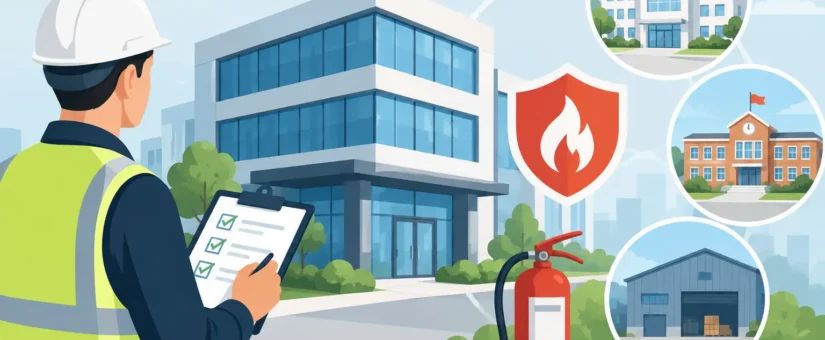
Who Needs Fire Assessments for UK Premises?
- Posted by Sam Yates
- On September 28, 2026
- 0 Comments
A lender asks for a report before completion. An insurer requests evidence at renewal. Or a tenant raises concerns about a blocked escape route. These are often the moments when property stakeholders ask who needs fire assessments. In most cases, the more precise question is whether the premises require a documented fire risk assessment – and who is legally responsible for arranging it.
For premises in England and Wales, the Regulatory Reform (Fire Safety) Order 2005 places duties on the person with control of a non-domestic building or its relevant common parts. The duty is not limited to large employers, high-rise blocks or obviously hazardous sites. Small offices, rented commercial units and community buildings can all fall within scope.
Who needs fire assessments under fire-safety law?
A fire risk assessment is required for virtually all non-domestic premises. That includes workplaces, shops, warehouses, restaurants, hotels, care settings, schools, halls and places of worship. It also applies to the common areas of residential buildings, such as shared corridors, staircases, entrance lobbies, plant rooms and bin stores.
The assessment must identify fire hazards, people at risk and the measures needed to prevent fire and enable safe escape. It should consider the building as it is actually used, rather than relying on a generic checklist or a previous report that no longer reflects the premises.
The legal duty normally sits with the responsible person. This may be an employer, owner, landlord, freeholder, facilities manager or person who otherwise controls the premises. A managing agent may organise the assessment, but this does not automatically transfer the underlying duty from the responsible person.
Where several parties have control, such as a multi-let office building or mixed-use development, they must co-operate and co-ordinate their fire-safety arrangements. Clear responsibility is particularly important where one party controls the common parts and others control individual units.
Premises that commonly require a fire risk assessment
Commercial property is the clearest example. If a business occupies an office, retail unit, workshop, industrial site, salon, restaurant or storage facility, it will normally need a suitable and sufficient assessment. The same is true for charities, sports clubs, community organisations and public-sector bodies using non-domestic premises.
Residential buildings can cause more uncertainty. A single private dwelling is not generally covered by the Fire Safety Order. However, the common parts of blocks of flats, converted houses and many houses in multiple occupation are covered. This means a freeholder, landlord or management company may need an assessment even where the individual flats themselves are private homes.
Mixed-use buildings need careful attention. A shop with flats above, for example, may have separate risks and responsibilities around the commercial unit, shared entrance, stairway and means of escape. The arrangement of the building, occupancy and lease obligations all matter. A site inspection is the most reliable way to establish what needs to be assessed.
Healthcare and education settings require particular care because occupants may need assistance to evacuate or may be unfamiliar with the building. Care homes, clinics, nurseries, schools and supported accommodation should assess the practical reality of evacuation, staffing levels, alarm arrangements and the needs of vulnerable people. A satisfactory report must do more than state that an alarm is present.
Landlords, freeholders and HMO operators
Landlords are not automatically responsible for every part of every rented property, but they should not assume that domestic letting removes all fire-safety duties. In a block of flats, the person responsible for common areas must ensure that a fire risk assessment is completed and kept under review. This can include external wall construction and flat entrance doors where relevant to the overall fire risk.
For HMOs, the position can overlap with housing standards enforced by local authorities. Shared escape routes, fire doors, detection, emergency lighting and management arrangements may all require attention. The Fire Safety Order can apply to common parts, while separate housing legislation may impose further obligations. The correct scope depends on the layout and use of the house.
Leasehold arrangements should also be checked closely. A lease may require a managing agent to commission reports, while the freeholder retains wider obligations. It is sensible to document who will instruct the assessor, receive the report, fund remedial work and communicate with residents. Confusion after an inspection is one of the most common causes of delayed action.
What about small businesses and sole traders?
Size does not remove the need for a fire risk assessment. A small office above a shop, a two-person consultancy, a café or a workshop may have relatively straightforward risks, but the duty can still apply. The assessment should be proportionate to the premises. A compact, low-risk unit will not require the same depth of control measures as a large factory, hotel or complex residential block.
Since changes to the Fire Safety Order came into force, responsible persons must record their fire risk assessment findings and the fire-safety arrangements identified, regardless of the number of employees. They must also record the name of the person appointed to assist with fire-safety measures where applicable. Written evidence is therefore not merely helpful for insurers, landlords and enforcement officers – it is an essential part of compliance.
When should a fire assessment be reviewed?
There is no single annual renewal date that suits every building. The assessment must be reviewed regularly and whenever there is reason to believe it is no longer valid. The right frequency depends on the building, the people using it and the level of risk.
A review is particularly necessary after a material change, including:
- alterations to the layout, structure, use or means of escape;
- a new tenant, change in occupancy or significant increase in visitor numbers;
- installation or alteration of alarms, emergency lighting, fire doors or suppression systems;
- a fire, near miss, enforcement visit or repeated fire-safety concern.
A report produced several years ago may still provide useful background, but it should not be treated as current simply because no one has asked for it. Buildings change gradually: storage accumulates in corridors, staff change, fire doors are damaged, and procedures are forgotten. Regular review turns the assessment into a working control document rather than a file kept for an audit.
Does the assessment need to be completed by a professional?
The law requires the responsible person to ensure that the assessment is suitable and sufficient. It does not state that every assessment must be completed by an external consultant. For a simple, low-risk premises, a competent person with appropriate knowledge may be able to carry it out.
That said, competence matters. Complex buildings, sleeping accommodation, vulnerable occupants, mixed-use sites, HMOs, substantial premises and buildings with previous deficiencies usually benefit from an independent, competent assessor. The cost of an unclear or incomplete report can be far greater than the cost of obtaining sound advice, particularly where insurance, enforcement action, a sale or refinancing is involved.
A professional assessment should set out the significant findings in clear terms, explain the risk level and identify practical actions with priorities. It should also provide evidence that the premises have been considered using a recognised approach, such as PAS 79 methodology. This gives owners and duty holders a usable record for insurers, lenders, conveyancers and enforcing authorities.
England, Wales and the wider UK
The Regulatory Reform (Fire Safety) Order 2005 applies in England and Wales. Scotland and Northern Ireland have different fire-safety legislation and enforcement arrangements, even though the core expectation is similar: duty holders must manage fire risk in relevant premises.
If a property portfolio crosses national borders, avoid assuming that one template, interval or process automatically satisfies every jurisdiction. The building type and local legal framework should be checked before commissioning work or relying on an existing report.
For property owners and managers in London and the South East, arranging an assessment early is often the simplest route through a transaction, renewal or compliance query. Firelux can provide a thorough site inspection, an insurance-compliant digital report and clear advice on the actions that genuinely need attention – helping you make informed decisions before a small uncertainty becomes an urgent problem.


0 Comments