
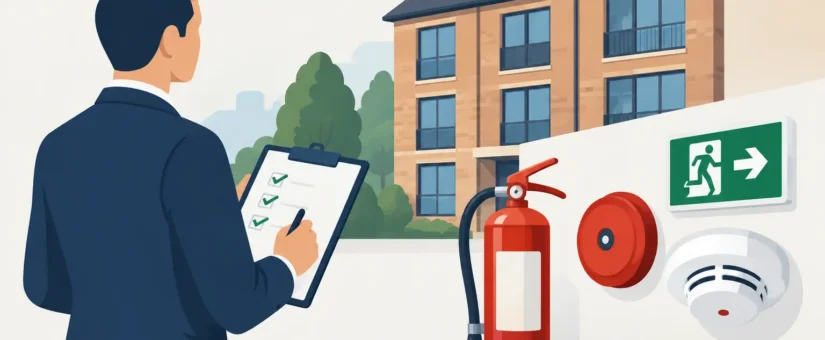
HMO Fire Regulations: What Landlords Must Do
- Posted by Sam Yates
- On October 14, 2026
- 0 Comments
A missing self-closer, an unsuitable alarm system or a blocked hallway can turn an otherwise well-managed house in multiple occupation into a serious life-safety risk. HMO fire regulations are not a single checklist: they bring together landlord duties, licensing conditions, fire-risk assessment requirements and practical measures that must work when residents need them most.
For landlords and managing agents, the objective is clear. Residents must be able to detect a fire promptly, leave by a protected route and reach a place of safety. The right measures depend on the building, its occupants and how it is managed. A converted three-storey shared house requires a different approach from a large, separately occupied flat conversion.
Which HMO fire regulations apply?
In England, HMOs are principally governed by the Housing Act 2004 and the Management of Houses in Multiple Occupation (England) Regulations 2006. Local authorities enforce housing standards through the Housing Health and Safety Rating System and may impose conditions through mandatory, additional or selective licensing schemes.
Fire safety also sits within the Regulatory Reform (Fire Safety) Order 2005. This applies to the common parts of multi-occupied residential buildings, including relevant common areas in HMOs. The person with control of those areas, often the landlord, freeholder or managing agent, may be the responsible person and must take general fire precautions.
The precise legal position can vary according to tenure, layout and the areas under a person’s control. Requirements also differ across the UK. This article focuses on England; landlords in Wales, Scotland and Northern Ireland should check the applicable national rules and local authority standards rather than assuming an English licensing benchmark applies.
A licence does not replace ongoing fire-safety management. Equally, meeting a basic national standard does not necessarily satisfy a council’s licence condition. Licensing teams may specify the alarm grade, fire-door provision, emergency lighting, escape-route protection or inspection frequency expected for a particular property.
Start with a suitable fire risk assessment
A suitable and sufficient fire risk assessment is the foundation for sensible decisions. It should consider who may be at risk, how a fire might start, how smoke could spread, the available escape routes and whether existing controls are adequate.
In an HMO, the assessment needs to look beyond the physical fabric. Consider the residents’ likely familiarity with the building, the use of bedrooms for cooking or charging devices, refuse storage, smoking controls, security arrangements and whether anyone may need assistance to evacuate. A locked communal door that protects residents from intruders can create a dangerous delay if it cannot be opened easily from inside during an emergency.
A competent assessment should record significant findings, identify priorities and set out practical actions. PAS 79 methodology provides a recognised structure for documenting the assessment process. Clear evidence is particularly valuable where an insurer, lender, conveyancer or enforcing authority needs to see what was assessed, what was found and how outstanding actions are being controlled.
Risk assessments must be reviewed when circumstances change, not simply filed away. Examples include major alterations, a change in occupancy, a fire incident, repeated false alarms, installation of new equipment or the discovery of a significant defect. Even where nothing obvious has changed, periodic review is good practice because buildings, management arrangements and residents’ behaviour do not stand still.
Avoid copying measures from another property
Landlords often ask whether every HMO needs the same doors, alarms and emergency lighting. It depends. A higher-risk layout, such as a property with several storeys, an inner room arrangement, a basement bedroom or a single long escape route, may justify more substantial protection than a straightforward two-storey shared house.
The right question is not, “What did the property down the road install?” It is whether the measures in this building give residents a realistic, reliable opportunity to escape. Local authority licence conditions and a competent fire-risk assessment should inform that answer.
Detection and alarm systems
Early warning is central to HMO fire safety. The required system will depend on the property’s risk profile and local requirements. In many HMOs, a Grade D LD2 system is commonly expected: mains-powered, interlinked smoke alarms in circulation spaces forming escape routes and heat detection in kitchens. Some properties require a more extensive category of coverage or a Grade A system with a control panel and automatic fire detection.
Do not treat terminology as a substitute for assessment. The grade describes the equipment arrangement, while the category describes the areas covered. A system can be installed to a recognised standard yet still be unsuitable if detectors are missing from risk areas, sounders cannot be heard in bedrooms or alterations have compromised the installation.
Testing, servicing and record keeping matter as much as installation. Residents should know the alarm’s sound, what to do when it operates and how to report faults. Landlords or managers should have a clear routine for functional tests, periodic servicing by a competent person and prompt investigation of unwanted alarms. Repeated false alarms encourage residents to ignore a real warning.
Carbon monoxide alarms are a separate but related obligation. Where solid-fuel appliances are present, landlords must meet the applicable alarm requirements. Carbon monoxide detection does not replace smoke or heat detection.
Escape routes, fire doors and compartmentation
The escape route is only useful if it remains available from the moment a fire begins. Hallways, stairs and landings should be kept clear of bikes, prams, furniture, refuse and storage. The route should lead residents quickly to safety, with final exits that can be opened without a key from the inside.
Fire doors are often a crucial part of protecting the route. Where required, a fire door should be the correct specification, fitted properly and maintained as a complete assembly. A door with excessive gaps, damaged seals, missing hinges, a defective closer or a lock that prevents straightforward escape may not provide the protection intended.
Self-closing doors can be unpopular with residents, particularly where noise or ventilation is a concern. Removing or wedging them open is not an acceptable workaround. If the closer is difficult to use or slams excessively, have it adjusted or replaced by a competent person. The solution should support everyday use without compromising fire separation.
Compartmentation also needs attention. Holes around pipes, cables and service risers can allow smoke and fire to bypass otherwise sound walls and floors. Loft hatches, understairs cupboards and later refurbishments are common places for defects to appear. These details are easily missed during routine property visits but can have a significant effect on escape conditions.
Ongoing management is part of compliance
The HMO Management Regulations require managers to maintain fire-fighting equipment and fire alarms in good working order, keep escape routes clear and ensure means of escape are maintained. In practice, this requires a documented management system rather than an annual visit followed by silence.
Useful records include alarm tests and servicing, emergency-lighting checks where installed, fire-door inspections, reported defects, repairs completed, resident fire-safety information and reviews of the fire risk assessment. The records should be proportionate, legible and available when needed. Digital reporting and secure cloud access can make this far easier for busy landlords, agents and portfolio managers.
Residents also need straightforward information. They should understand that communal routes must remain clear, fire doors must not be wedged open, alarm faults must be reported immediately and any evacuation procedure must be followed. For many HMOs, a simple instruction to leave the building promptly on hearing the alarm and call 999 from a safe place is more effective than a complicated notice nobody reads.
Where a property is occupied by people who may be vulnerable, unfamiliar with English or less able to self-evacuate, management arrangements may need to go further. This could mean tailored communication, closer liaison with support workers or a personalised evacuation plan. It should be approached carefully and based on the individual risk, not assumptions about a person’s capabilities.
Common failures that create avoidable risk
The most persistent shortcomings are rarely dramatic. They include unsuitable domestic smoke alarms where an interlinked system is needed, missing heat detectors in kitchens, bedroom doors without closers where protection is required, poorly maintained fire doors, obstructions on stairs and no evidence that systems have been tested.
Another frequent issue is treating refurbishment as purely cosmetic. Replacing doors, altering a kitchen, converting a loft, adding locks or rerouting services can change the fire strategy. Check the implications before works begin, particularly where the project affects escape routes, structural fire separation or detection coverage.
If a fire-risk assessment identifies significant deficiencies, prioritise action according to the risk rather than postponing every item until a larger refurbishment. Some measures, such as clearing a staircase, repairing a faulty closer or restoring an alarm circuit, may need immediate attention. Others may be planned and monitored, provided the remaining risk is properly managed.
For landlords managing occupied HMOs across London and the South East, arranging an inspection around residents and acting on findings promptly can be challenging. A thorough, clearly documented assessment gives you a practical route forward: what needs attention now, what should be improved, and what evidence should be retained. Firelux can support this process with assessed findings, actionable reporting and advice that reflects the building rather than a generic template.
A safe HMO is maintained through small, consistent decisions. Keep the route clear, keep the warning system reliable, deal with defects when they are found and make sure the paperwork shows the care behind the property management.


0 Comments