
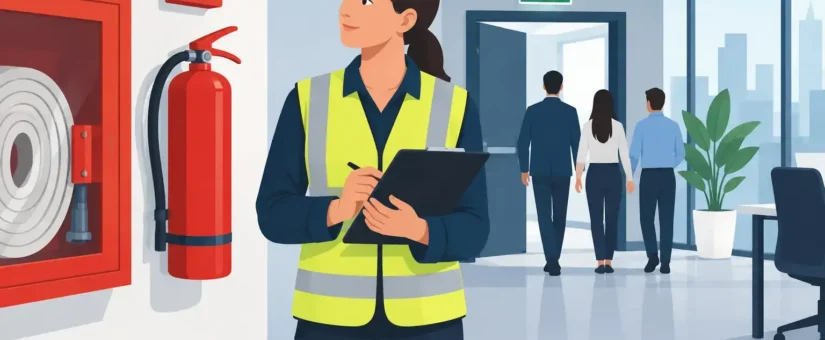
Fire Safety Responsibilities Guide for UK Premises
- Posted by Sam Yates
- On November 21, 2026
- 0 Comments
A fire risk assessment that sits unread in a shared drive will not protect a tenant, member of staff or visitor when conditions change. This fire safety responsibilities guide explains who must act, what practical action looks like, and how UK dutyholders can keep evidence of compliance that stands up to insurer, lender and enforcement scrutiny.
Who carries fire safety responsibility?
For most non-domestic premises in England and Wales, the Regulatory Reform (Fire Safety) Order 2005 places duties on the Responsible Person. This is usually the employer where the workplace is under their control, the owner or landlord where they control the building, or the managing agent or facilities provider where responsibility has been formally delegated and sufficient control exists.
The title is less important than the reality of control. The Responsible Person must take general fire precautions to ensure, so far as is reasonably practicable, the safety of employees and anyone lawfully on or near the premises. In a block of flats, this normally concerns common parts, plant rooms, escape routes and shared systems. Inside an individual flat, responsibilities can differ, particularly where the building’s fire strategy relies on compartmentation and a stay-put approach.
More than one party may have duties. A freeholder, leaseholder, managing agent, commercial tenant and contractor can each control different risks. Where this happens, they must co-operate, co-ordinate their arrangements and share relevant fire-safety information. A managing agent may arrange inspections, for example, but the property owner should not assume that this removes every legal or financial exposure.
Scotland and Northern Ireland operate under different fire-safety legislation. The principles of identifying risks, maintaining precautions and documenting action remain relevant, but dutyholders should obtain advice under the legislation that applies to their premises.
Fire safety responsibilities guide: the core duties
A competent and suitable fire risk assessment is the foundation. It should identify people at risk, fire hazards, existing control measures, shortcomings, and a prioritised action plan. Larger or more complex sites need more than a generic checklist. The assessment must reflect the actual building, its occupants, operations, layout, fire strategy and management arrangements.
Where five or more people are employed, or the premises require a licence or are subject to an alterations notice, significant findings and the measures taken must be recorded. In practice, written records are sensible for nearly every managed property. They show what was found, who owns each action, when it is due, and whether it has been completed.
The Responsible Person must also provide and maintain appropriate precautions. Depending on the premises, these may include fire doors, protected escape routes, emergency lighting, fire alarms, extinguishers, signage, smoke control, compartmentation and firefighting access. The correct provision is not identical in every building. Installing more equipment is not automatically safer if it conflicts with the fire strategy or is poorly maintained.
Suitable emergency procedures are equally essential. People need to know how an alarm is raised, how they leave safely, where they assemble and how assistance will be provided to anyone who may need it. In an office this may involve trained fire wardens and evacuation drills. In a residential building, the appropriate procedure may be based on the building’s design and the advice given to residents, rather than a routine whole-building evacuation.
Turning legal duties into day-to-day control
Compliance is sustained through routine management, not achieved by commissioning a report once. A clear responsibility schedule helps prevent essential tasks being missed between inspections. It should identify the person or contractor responsible, the frequency of the check, the evidence required and the route for escalating defects.
The following areas commonly require active management:
- Escape routes must remain clear, usable and adequately lit. Storage in corridors, wedged-open fire doors and locked final exits can quickly turn a manageable risk into a serious failure.
- Fire doors need regular visual inspection and prompt repair. Check that self-closers operate, intumescent seals are present where required, gaps are appropriate, and doors have not been damaged or altered.
- Alarm, emergency lighting and firefighting equipment need inspection and testing at appropriate intervals by competent persons. Keep certificates, test records and repair documentation together.
- Building works, changes of use and changes in occupancy need fire-safety review. A new partition, additional sleeping accommodation or altered reception area can affect escape, detection and fire separation.
- Staff, tenants and relevant contractors need information proportionate to the risk. Contractors carrying out hot works, for instance, require controls that go beyond a standard induction.
Frequency is not a substitute for judgement. A weekly alarm test may be suitable for many workplaces, but a defect in a critical escape route needs attention immediately. Equally, a minor issue may need planned repair rather than an unnecessary emergency call-out. The key is that risk, timescale and decision-making are documented.
When a fire risk assessment must be reviewed
There is no universal expiry date that makes an assessment automatically invalid. The law requires review regularly and whenever there is reason to believe it is no longer valid, or there has been a significant change. Many organisations adopt an annual review cycle, with a more thorough reassessment at suitable intervals according to building complexity and risk. That approach can be sensible, but it must not delay action after a material change.
Triggers for review include a fire, false alarm trend, enforcement advice, refurbishment, new equipment, vulnerable occupants, a change from office to sleeping use, or recurring maintenance failures. In residential settings, poor fire-door condition, unauthorised alterations in common areas and incomplete records are frequent reasons to reassess control measures.
A review should not merely update the date on an old document. It should verify whether the stated controls are still in place and effective. If a previous report required remedial work, the reviewer should see evidence of completion or record why an alternative measure has been adopted.
Competence, documentation and the evidence trail
The Responsible Person may appoint competent people to assist with fire safety, but cannot simply outsource accountability. Competence means having sufficient training, knowledge, experience and other qualities for the work involved. A simple, low-risk shop may be managed differently from a care setting, a converted block, a school or a multi-let commercial building.
For substantial, complex or higher-risk premises, an independent assessment prepared to a recognised methodology such as PAS 79 can provide a clearer basis for decisions. A detailed report should explain the reasoning, not just assign a score. It should identify practical actions, their priority, and the areas inspected, while making clear any access limitations.
Good records matter because they allow the next person in the chain to understand the position. Keep the current risk assessment, action plan, alarm and emergency-lighting logs, maintenance certificates, drill records, staff training records, fire-door checks and correspondence about significant defects in an accessible location. Digital access is particularly useful where landlords, agents and facilities teams need to respond quickly during a transaction, insurance query or inspection.
Avoiding the gaps that create risk
The most common weakness is unclear ownership. One party believes the managing agent will arrange repairs, another assumes the tenant will report defects, and no one checks completion. Assign every action to a named role, give it a realistic deadline and record closure with supporting evidence.
Another recurring issue is treating occupied premises as too difficult to inspect properly. Access does require care, especially in tenant-occupied buildings, schools, healthcare environments and busy workplaces. However, flexible scheduling, clear advance communication and phased inspections can usually protect occupants while allowing a competent assessment to be completed.
Fire safety is also affected by decisions made outside the facilities team. Procurement may replace a door, a contractor may penetrate a fire-resisting wall, or a lettings team may change the use of a room. A simple process requiring fire-safety sign-off before material alterations can prevent costly remedial work later.
A practical next step for responsible persons
Start by checking whether your current assessment reflects the building as it is now, whether outstanding actions have an owner and deadline, and whether maintenance evidence is easy to produce. If the answer to any of those questions is unclear, arrange a competent review before an insurer, lender or enforcing authority asks for it.
For property stakeholders across London and the South East, Firelux can support this process with thorough, documented assessments and clear, actionable reporting. The objective is not paperwork for its own sake. It is a managed fire-safety position that protects people, supports compliance and gives you confidence when scrutiny arises.


0 Comments