
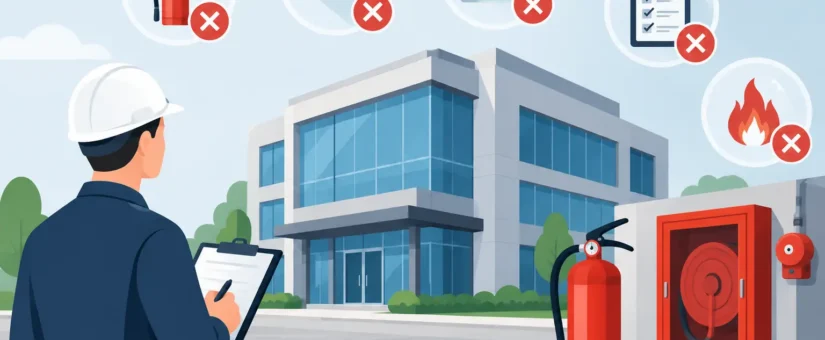
7 Commercial Fire Compliance Mistakes to Avoid
- Posted by Sam Yates
- On October 28, 2026
- 0 Comments
A fire risk assessment may appear satisfactory on paper, yet a blocked final exit, an out-of-date alarm test record or an unclear evacuation procedure can quickly expose the responsible person to serious risk. Commercial fire compliance mistakes are rarely caused by a single dramatic failure. More often, they develop through small omissions that go unchallenged while a building, its occupants or its day-to-day use changes.
For UK businesses, landlords and property managers, compliance is not simply about arranging an inspection. It is about understanding the risks in the premises, acting on findings and maintaining clear evidence that fire precautions remain suitable. The Regulatory Reform (Fire Safety) Order 2005 places these duties on the responsible person, and enforcement authorities will look beyond whether a report exists.
1. Treating the fire risk assessment as a one-off document
A suitable and sufficient fire risk assessment is the foundation of fire-safety management, but it is not a certificate that lasts indefinitely. It should reflect the building as it is actually used, the people who occupy it and the measures in place to control fire risk.
A review is needed when circumstances change. This may include a refurbishment, a new tenant, altered internal layouts, a change in working hours, new equipment, increased storage, or the arrival of people who may need additional assistance to evacuate. Even where no obvious change has occurred, the assessment should be reviewed regularly to confirm that its findings remain accurate.
The common mistake is filing a previous report away without checking whether its recommendations were completed. A professional assessment aligned with PAS 79 methodology creates a documented basis for action, but it must be supported by an active review process and a clear record of remedial works.
2. Assuming someone else is responsible
Responsibility can become blurred in multi-let offices, mixed-use premises, HMOs and buildings managed by several parties. A freeholder may assume the managing agent is dealing with common areas. A tenant may believe the landlord maintains every fire precaution. Facilities teams can assume contractors have completed work because it was requested.
Those assumptions create gaps. The responsible person is commonly the employer, owner, landlord, managing agent or another person with control over all or part of the premises. There can be more than one responsible person, which makes co-operation and co-ordination essential rather than optional.
Written responsibilities should make clear who manages the fire alarm, emergency lighting, extinguishers, fire doors, escape routes, staff training and assessment reviews. This is especially important where different businesses share a building. A contractor’s service sheet may demonstrate that a visit took place, but it does not remove the need for the dutyholder to check that the work is appropriate and any faults are resolved.
3. Leaving fire doors, escape routes and compartmentation unchecked
Fire doors and compartment walls are often overlooked because they are built into the premises rather than viewed as active safety equipment. Yet they perform a critical role: containing fire and smoke long enough for people to escape and for emergency services to respond.
Typical failures include wedged-open fire doors, damaged seals, poorly adjusted closers, missing signage, gaps around service penetrations and doors that do not close fully into their frames. In older or altered buildings, cabling and pipework may have been installed through walls and ceilings without suitable fire stopping. These defects can compromise the intended separation between escape routes, offices, flats, storage rooms or higher-risk areas.
Escape routes require equally close attention. They must be available, appropriately signed, adequately lit and free from obstructions. Boxes in corridors, furniture on stair landings and stock stored near final exits may seem temporary, but they can delay evacuation at precisely the wrong moment.
Regular visual checks are valuable, particularly in occupied premises where conditions change quickly. More detailed inspection may be necessary where a fire risk assessment identifies concerns about doors, compartmentation or the building’s construction.
4. Confusing equipment servicing with full compliance
A maintained fire alarm system, extinguishers and emergency lighting are essential, but servicing equipment alone does not prove the premises are compliant. Fire precautions must work together as part of a suitable strategy for the building.
For example, an alarm may be tested regularly, yet staff may not know what the signal means, where to assemble or who checks that visitors have left. Emergency lighting may have a valid test record, but an altered corridor layout may no longer provide a safe route. Extinguishers may be in date, while the underlying fire hazards from unsafe charging, poor housekeeping or unsuitable storage remain unaddressed.
Keep accurate records of testing, maintenance, faults and repairs. Where defects are found, record the action taken and its completion date. If a recommendation cannot be completed immediately, document the interim controls and the reason for the delay. This creates a defensible audit trail for insurers, enforcing authorities and anyone reviewing the property during a sale, lease or refinancing process.
5. Using a generic evacuation plan
A downloaded template can be a useful starting point, but it cannot account for the practical realities of a specific premises. An evacuation arrangement for a small ground-floor shop will not be suitable for a multi-storey office, a care setting, a school or a building with sleeping accommodation.
The plan should reflect the alarm arrangement, escape routes, assembly point, fire marshal arrangements, visitor procedures and the needs of people who may require assistance. Personal Emergency Evacuation Plans may be appropriate for identified individuals, while a more general approach may be needed for people who are not known in advance, such as customers or visitors.
Training also matters. New starters, agency staff, contractors and volunteers need relevant instruction. Fire drills should test whether the procedure works in practice, not merely whether people leave the building. If a drill exposes confusion, congestion or a missed area, treat it as useful evidence and amend the plan.
6. Delaying remedial work because the risk feels manageable
Not every recommendation carries the same urgency. A competent assessment should distinguish between issues that need prompt attention and improvements that can be planned into maintenance or refurbishment works. The mistake is to treat every action as negotiable because there has never been a fire.
Risk is shaped by likelihood, consequence and the people exposed. A damaged fire door on a rarely used store may require a different response from a blocked escape route in a busy workplace. However, cost, inconvenience or a pending lease renewal do not make a serious deficiency acceptable.
Create an action plan with named owners, realistic deadlines and a method for verifying completion. Where a problem requires specialist work, obtain clear scope, competent installation and evidence of what has been completed. Photographing remedial works and retaining invoices, certificates and updated drawings can make future reviews considerably easier.
7. Choosing assessment support on price alone
A low-cost report can be expensive if it lacks detail, overlooks material risks or leaves the responsible person unclear about what to do next. Equally, a long report filled with generic statements is not necessarily useful. The value lies in a competent inspection, sound judgement, practical recommendations and documentation that accurately reflects the premises.
Ask whether the assessor is suitably competent for the building type and complexity, whether the report follows a recognised methodology, and whether recommendations are prioritised and explained. Consider the level of aftercare available if you need clarification, urgent scheduling or help interpreting requirements identified during the inspection.
This is particularly relevant for complex, occupied or time-sensitive properties. A lender, insurer, conveyancer or enforcement authority may require clear evidence quickly, but speed should not mean a superficial assessment. Firelux supports property stakeholders across London and the South East with documented assessments, practical advice and responsive scheduling where compliance timescales are tight.
Keeping compliance live, not merely documented
The most reliable approach is to treat fire safety as an operational discipline. Review risks when the premises changes, inspect the measures people rely on every day, keep records accessible and close out actions with evidence. This protects occupants first, while also giving responsible persons the clarity needed to demonstrate that their legal duties are being actively managed.
If a report is overdue, a recommendation remains unresolved or a building’s use has changed, early professional advice is usually simpler and more cost-effective than responding after an insurer, lender or enforcing authority raises a concern.

0 Comments