
Landlord Fire Safety Compliance Guide for UK Lets
- Posted by Sam Yates
- On October 2, 2026
- 0 Comments
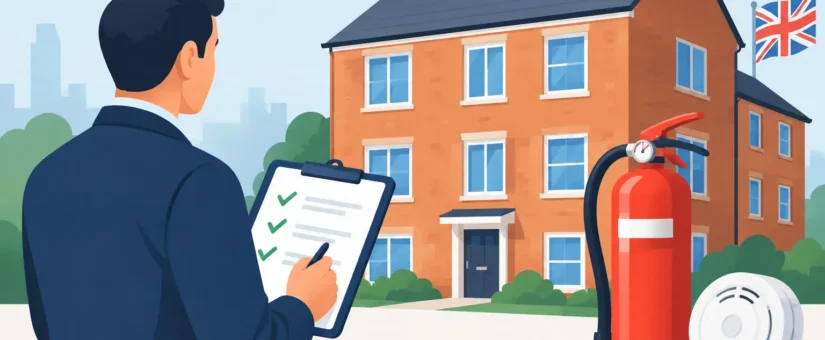
A tenancy can be ready to sign while a fire-safety gap remains hidden in plain sight: a wedged-open communal fire door, an alarm with no testing record, or a hallway used for storage. This landlord fire safety compliance guide sets out the practical duties behind those details, helping UK landlords protect occupants and demonstrate that reasonable, documented action has been taken.
The starting point is not buying more equipment. It is understanding which rules apply to the building, who holds the legal duty, and whether the measures in place match the risks. A single rented house, an HMO, a converted block and a mixed-use building can have very different compliance requirements.
Start with the building and the responsible person
For workplaces and the common parts of multi-occupied residential buildings, the Regulatory Reform (Fire Safety) Order 2005 generally applies in England and Wales. The person with control of the premises – often the freeholder, managing agent, employer or landlord – may be the Responsible Person. Their duties include taking general fire precautions, arranging a suitable and sufficient fire risk assessment, acting on significant findings, and maintaining fire-safety measures.
A private landlord is not automatically responsible for every part of every building. In a block of flats, for example, responsibility may be split between the landlord of an individual flat and the party managing communal corridors, stairwells and plant rooms. Where duties overlap, the relevant parties must co-operate and share information. Assumptions are a poor substitute for a written allocation of responsibilities.
The Fire Safety Act 2021 clarified that, when assessing buildings containing two or more domestic premises, the structure, external walls and flat entrance doors can fall within the assessment scope. The Fire Safety (England) Regulations 2022 also create further duties for certain higher-risk residential buildings, particularly those over 11 metres and high-rise buildings over 18 metres or seven storeys. These can include enhanced checks, information sharing and wayfinding provisions.
Requirements also differ across the UK. This guide focuses principally on the framework used in England and Wales. Landlords in Scotland and Northern Ireland should confirm the applicable national rules, while HMO operators should also check local authority licensing conditions.
Landlord fire safety compliance guide: assess the actual risks
A fire risk assessment is not a generic certificate and should not be treated as a one-off property transaction document. It is a structured review of how a fire could start, who could be harmed, how they would escape, and what controls are needed to reduce the risk.
A competent assessor will consider ignition sources such as cooking, electrical equipment, heaters, smoking and contractor activity. They will also review combustible materials, escape routes, fire doors, emergency lighting, signs, alarms, detection, firefighting equipment and the needs of vulnerable occupants. In a shared house, a locked rear exit or overloaded extension lead may be more consequential than a minor cosmetic defect.
The assessment must be suitable for the premises. A small, low-risk property may require a proportionate approach, while an HMO, a building with commercial units, or a property with complex evacuation arrangements requires greater scrutiny. PAS 79 methodology provides a recognised framework for documenting this work clearly and consistently.
Keep the resulting report, record significant findings, and make sure recommendations are assigned and closed out. A report identifying deficiencies is valuable, but it does not by itself make a building compliant. The work completed afterwards is what reduces the risk.
Review when something changes
There is no universal rule that every fire risk assessment must be renewed annually. It should, however, be reviewed regularly and whenever there is reason to believe it is no longer valid. Relevant triggers include a fire or near miss, building alterations, a change of use, new tenants with additional support needs, changes to communal areas, or installation of new fire-safety systems.
For larger or higher-risk premises, a planned review schedule is sensible. It gives property managers evidence of ongoing control rather than a report that sits unread in a folder.
Provide early warning and keep it working
In England, the Smoke and Carbon Monoxide Alarm (England) Regulations require private landlords to ensure smoke alarms are installed on every storey used as living accommodation. Carbon monoxide alarms are required in rooms used as living accommodation that contain a fixed combustion appliance, excluding gas cookers. Landlords must repair or replace alarms once informed by a tenant that they are not working.
These are minimum duties, not necessarily the full fire strategy. HMOs may need a more comprehensive, appropriately designed automatic fire detection and alarm system. The category, coverage, testing regime and maintenance requirements should reflect the property layout, occupancy and local licensing conditions.
Landlords should be able to show that alarms were checked at the start of a tenancy and that periodic tests and maintenance have been managed thereafter. For communal systems, maintain a clear logbook covering tests, faults, servicing and remedial actions. An alarm that exists but cannot be shown to function is difficult to rely on after an incident.
Protect escape routes and fire separation
Escape routes need to remain usable at all times, not merely look clear during an inspection. Communal hallways and stairs should not become storage areas for bicycles, prams, furniture, refuse or deliveries. These items can fuel a fire, obstruct evacuation and restrict firefighter access.
Fire doors are equally significant. In buildings where they are required, doors should close properly into their frames, have suitable self-closing devices where specified, and not be damaged, propped open or altered in a way that compromises their fire-resisting performance. Flat entrance doors in relevant blocks deserve particular care because they support the building’s compartmentation strategy.
Do not assume that installing additional locks, security grilles or internal partitions is harmless. Any change that makes escape slower, narrows a route or affects fire separation should be considered through the fire risk assessment process before work proceeds.
Control the practical causes of fire
A reliable compliance file should connect fire safety with the wider maintenance programme. Electrical safety checks, gas safety duties, portable appliance management where relevant, boiler servicing, extraction maintenance and contractor controls all affect the likelihood of fire.
Particular attention is needed where tenants share kitchens, where e-bikes or e-scooters are charged, or where temporary heaters are used. A blanket ban may be impractical and difficult to enforce, but clear tenancy information and sensible charging arrangements can materially reduce risk. Communal areas should never be used for charging devices if that creates an obstruction or introduces an unmanaged ignition source.
For HMOs, give tenants simple, usable instructions: keep doors closed, do not disable alarms, report faults immediately, keep escape routes clear and leave the building if the alarm sounds unless the building’s documented strategy says otherwise. The right instructions depend on whether the premises operate a simultaneous evacuation or stay-put approach. Never issue generic evacuation advice that conflicts with the building’s fire strategy.
Keep records that stand up to scrutiny
Good records make compliance manageable, especially when a managing agent, lender, insurer or enforcement authority asks for evidence quickly. Store the fire risk assessment, action plan, alarm and emergency-lighting records where applicable, fire-door inspections, service certificates, repair evidence and relevant tenant communications together.
Digital access is particularly useful for occupied premises and portfolios, as it reduces the risk of a vital report being held by a former agent or lost between transactions. It also helps demonstrate which recommendations remain open, who owns them and when they are due.
When commissioning an assessment, ask whether the report is clear enough for insurers, conveyancers and lenders to understand its scope and findings. A thorough report should identify practical priorities, not bury urgent life-safety actions beneath vague wording.
Get competent help before an urgent deadline
Fire-safety responsibilities can feel most difficult when a sale, refinance, licence renewal or enforcement query is already underway. Leaving an assessment until that point often creates avoidable pressure, particularly if works are then needed before a deadline can be met.
An experienced assessor can inspect the property, explain what applies to its use and occupancy, and produce a formal, actionable report. Firelux provides PAS 79-aligned fire risk assessments with detailed digital reporting and flexible appointments for landlords and property managers across London and the South East.
The most useful next step is rarely a last-minute checklist. Walk the building as an occupant would, identify what could delay detection or escape, and make sure every action is documented, owned and completed.

0 Comments