
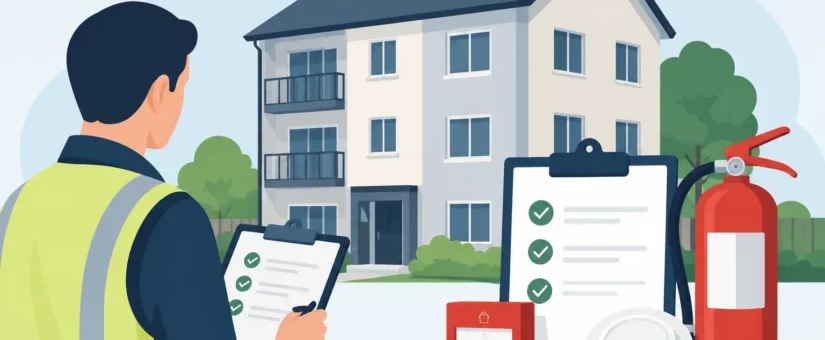
HMO Fire Risk Assessment Requirements Explained
- Posted by Sam Yates
- On September 16, 2026
- 0 Comments
A missing self-closer, an unreliable communal alarm or an unprotected escape route can turn a manageable HMO issue into an immediate risk to tenants and a serious compliance problem for the landlord. HMO fire risk assessment requirements are not a paperwork exercise. They are the practical process used to identify how a fire could start, who could be harmed, whether residents can escape, and what must be corrected.
For HMOs in England and Wales, the Regulatory Reform (Fire Safety) Order 2005 generally applies to communal areas. Wider duties under housing legislation, HMO licensing conditions and local authority standards can also apply to the building and its individual rooms. The exact measures needed depend on the property, the people living there and the way it is managed. A converted house occupied by four unrelated professionals will not necessarily need the same provisions as a three-storey HMO with vulnerable residents, bedsits and shared cooking facilities.
Who is responsible for HMO fire risk assessment requirements?
The responsible person is usually the person with control of the premises or its fire-safety arrangements. This may be the landlord, freeholder, managing agent or a combination of parties. In practice, responsibilities should be clearly agreed rather than assumed. If an agent arranges inspections but the owner controls the building works budget, both parties need a clear route for acting on the findings.
The responsible person must take general fire precautions, arrange a suitable and sufficient fire risk assessment, act on significant findings and maintain the necessary safety measures. They must also provide relevant fire-safety information to residents, contractors and others who may be affected.
A landlord can appoint a competent assessor, but cannot outsource legal responsibility. The report should therefore be treated as a working compliance document: read it, understand the priorities, allocate remedial works and retain evidence that actions have been completed.
What a suitable HMO assessment examines
A competent site assessment considers the whole route from ignition to safe escape, not simply whether smoke alarms are fitted. It should reflect the layout, construction, occupancy, management arrangements and known history of the property.
The assessment will normally examine:
- likely ignition sources, including cooking, electrical equipment, smoking, portable heaters and unsafe charging practices;
- combustible materials and how fire or smoke may spread through voids, service penetrations, stairways and poor compartmentation;
- escape routes, including travel distances, obstructions, lighting, final exits and whether residents can reach safety without passing through a high-risk area;
- fire doors, frames, seals, hinges, closers and any alterations that could compromise their performance;
- fire detection and warning arrangements, emergency lighting, fire-fighting equipment and safety signage where appropriate;
- management controls, such as alarm testing, emergency procedures, maintenance records, tenant information and arrangements for reporting defects.
This is why a generic online checklist is rarely enough. It cannot judge whether an internal door needs upgrading, whether a stair enclosure provides adequate protection, or whether the alarm design is suitable for the actual risk. Those decisions require inspection, professional judgement and a clear record of the reasoning.
The building must be considered as it is used
An HMO can change materially without an extension being built. Converting a reception room into a bedroom, adding a lock to a bedroom door, installing a loft room, or allowing more occupants can alter escape arrangements and fire loading. So can a change from a household of friends to separate tenancies with residents who have limited familiarity with one another.
The assessment should also account for residents who may need additional support to escape, including people with mobility limitations, sensory impairments or language barriers. A standard evacuation instruction may not be sufficient in every HMO.
Fire precautions: proportionate, not one-size-fits-all
The law requires suitable precautions, not a fixed shopping list for every shared house. However, HMOs commonly require a coordinated set of measures: appropriate automatic fire detection, protected escape routes, effective fire doors where risk assessment identifies them, suitable emergency lighting, and controls to reduce ignition and spread.
Alarm provision is a frequent area of confusion. The required category and coverage should be determined by the assessment, relevant British Standards and, where applicable, the local authority’s HMO licensing standards. An alarm system that is technically installed but poorly positioned, inadequately maintained or routinely ignored by occupants may offer little real protection.
Similarly, not every internal door automatically requires the same rating. Yet doors opening onto an escape route, bedroom doors and doors separating higher-risk areas often need close examination. A fire-resisting door only performs as intended when its frame, gaps, ironmongery, glazing and self-closing arrangement are compatible and in good condition.
Where the property is a multi-occupied residential building subject to the Fire Safety (England) Regulations 2022, additional duties may apply. These include specific requirements for fire-door checks in certain taller buildings and information for residents. HMO landlords should not assume that licensing compliance alone covers these separate fire-safety obligations.
Documentation that stands up to scrutiny
A useful HMO fire risk assessment should be specific enough for a landlord, contractor, insurer or enforcing authority to understand the premises and the action required. PAS 79 methodology is widely recognised as a structured approach to recording fire risk assessments, helping ensure the report addresses hazards, people at risk, existing controls, deficiencies and an action plan.
The report should identify significant findings and set out priorities. Immediate life-safety issues need prompt attention, while lower-risk improvements can be planned with sensible target dates. Photographs, location references and clear recommendations reduce ambiguity for contractors and help demonstrate a considered process if a concern is later raised.
Since October 2023, responsible persons must record their fire risk assessment and fire-safety arrangements. Keeping digital copies of the report, alarm tests, emergency-lighting checks, fire-door inspections, servicing records, tenant communications and completed remedial works creates a far stronger compliance trail than relying on verbal assurances.
An assessment is not a fire-safety certificate or a guarantee that no incident can occur. It is evidence that foreseeable risks have been assessed and managed through proportionate controls. Its value depends on the accuracy of the inspection and the landlord’s follow-through.
When should an HMO fire risk assessment be reviewed?
There is no universal legal rule that every HMO assessment expires after exactly 12 months. The responsible person must keep it under review and revise it where it is no longer valid or where there has been a significant change. Annual review is sensible for many HMOs because occupancy and property conditions can change quickly, but the correct interval should be risk-led.
A full review or reassessment is particularly prudent after a fire or near miss, structural alteration, conversion work, a change in occupancy profile, changes to the layout, new fire-safety systems, recurring alarm faults, or enforcement and insurer feedback. Even seemingly minor maintenance work can matter if it affects a fire door, escape route or compartment line.
Between formal reviews, routine checks are essential. Test and maintain systems in accordance with their design and servicing requirements, keep communal escape routes clear, investigate defects quickly, and ensure tenants know how to report concerns. Good management often prevents a minor defect becoming a serious finding at the next inspection.
Avoiding the common compliance gap
The most common weakness is not the absence of equipment. It is the gap between installing it and managing it. A smoke alarm may be present but untested. A fire door may have been painted, wedged open or fitted with an unsuitable replacement lock. An escape route may be clear at inspection but used for storage a fortnight later.
Another issue is relying only on an HMO licence. A licence and a fire risk assessment serve related but different purposes. Licensing conditions may specify minimum provisions, while the fire risk assessment examines the actual risks in the particular premises. Both need to be kept current.
For occupied HMOs, access and communication also matter. Inspections and remedial works need planning around tenants, but urgency should not be diluted. Clear appointment arrangements, documented findings and a staged action plan make it easier to protect residents without creating unnecessary disruption.
A thorough assessment provides more than a report for a file. It gives the responsible person a practical route to safer accommodation, clearer priorities and defensible evidence of active fire-safety management. When a change occurs in your HMO, treat it as a prompt to ask whether the existing assessment still reflects the building your tenants live in now.

0 Comments