
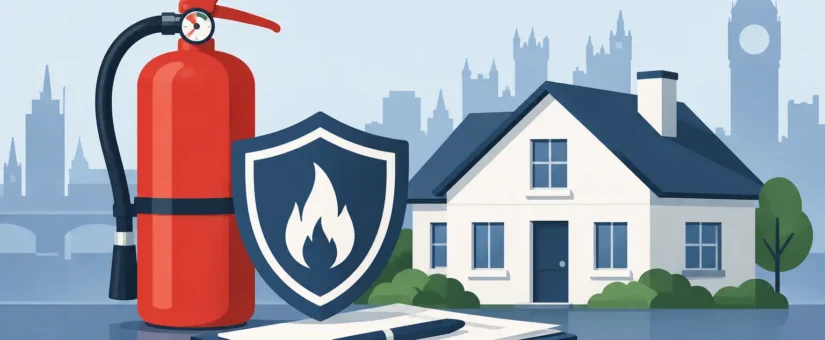
Fire Safety Liability for UK Property Owners
- Posted by Sam Yates
- On October 30, 2026
- 0 Comments
A missed fire door defect, an outdated risk assessment or an alarm fault left unresolved can quickly become more than a maintenance issue. Fire safety liability concerns the legal and practical responsibility to protect people from fire in non-domestic premises and the common parts of residential buildings. For landlords, freeholders, managing agents and facilities teams, the question is not simply whether a document exists. It is whether the required precautions are suitable, recorded, acted upon and kept under review.
The consequences of getting this wrong can include enforcement action, prosecution, fines, disrupted operations, insurance difficulties and, most seriously, harm to occupants. A clear understanding of responsibility is the starting point for managing that exposure.
Who carries fire safety liability?
In England and Wales, the Regulatory Reform (Fire Safety) Order 2005 places duties on the “Responsible Person“. This is usually the employer where a workplace is concerned. In other premises, it may be the person who has control of the building or control of its fire-safety arrangements, such as a landlord, freeholder, building manager, facilities manager or managing agent.
The title used in a contract is not decisive. The enforcement authority will look at who actually controls the premises and who has the ability to make decisions about fire precautions. A managing agent may carry substantial responsibilities where it manages common parts and contractors, while the freeholder or owner may retain responsibility for major works and investment decisions. In some buildings, more than one party may have duties.
For blocks of flats, the Fire Safety Order generally applies to communal areas, including corridors, stairways, plant rooms and entrance lobbies. It does not ordinarily apply to the interior of an individual domestic flat. That distinction matters, but it does not remove wider obligations that may arise under housing, leasehold, building-safety or tenancy law.
Where premises are shared, dutyholders must co-operate and co-ordinate their arrangements. A landlord cannot assume that a commercial tenant will deal with every risk, and a tenant cannot assume that a landlord is handling the risks within its occupied area. Responsibilities should be defined in writing, then checked against the reality of day-to-day control.
Delegating work does not delegate accountability
A competent assessor, alarm contractor or managing agent can provide essential expertise. However, appointing a third party does not automatically remove the Responsible Person’s duties. The Responsible Person still needs to ensure the work is appropriate, understand the significant findings and make sure the action plan is delivered.
This is particularly relevant when a report identifies defective fire doors, insufficient emergency lighting, inadequate escape-route protection or a need for an alarm upgrade. Filing the report without allocating actions, budgets and deadlines is unlikely to demonstrate effective management. A report is evidence of assessment, not evidence that the risks have been controlled.
What the law expects in practice
The central duty is to take general fire precautions that are reasonable and appropriate to the circumstances. In practical terms, this starts with a suitable and sufficient fire risk assessment. It should identify people at risk, consider likely fire hazards, evaluate escape arrangements and record the measures needed to reduce risk.
The assessment must reflect the actual building, not a generic checklist. A small office with a single protected stair presents different issues from an occupied HMO, care setting, school, place of worship or mixed-use block. Sleeping risk, vulnerable occupants, lone working, contractor activity, storage, cooking facilities and building alterations can all change the level of precaution required.
The Responsible Person must also put suitable arrangements in place for maintaining fire precautions. That may include routine alarm testing, emergency-lighting checks, fire-door inspections, extinguisher servicing, evacuation procedures, staff training and keeping escape routes clear. The appropriate regime depends on the premises and risk assessment findings. More testing is not automatically better if it is poorly targeted, but infrequent or undocumented checks can be difficult to defend after an incident.
Since changes to fire-safety legislation, written records have become increasingly significant. Keeping a dated assessment, documented findings, maintenance certificates, test logs and evidence of completed remedial works creates an auditable trail. It also supports continuity when a property is sold, a managing agent changes or a new Responsible Person takes over.
When exposure to liability increases
Fire safety liability is rarely created by one isolated administrative error. It usually increases when known issues are allowed to continue, responsibilities are unclear or building changes are not reflected in the assessment.
Common pressure points include refurbishment work that affects compartmentation, a change from office use to residential occupation, new tenants with different operating risks, or a building becoming more heavily occupied. An assessment may also need reviewing after a fire, a near miss, an enforcement visit, significant changes to the building or material changes to the people using it.
Records matter because they show whether concerns were identified and managed. If a fire door fault appears repeatedly in inspection notes but no repair is instructed, that pattern may be more damaging than a single missed check. The same applies where escape routes are regularly obstructed, false alarms are treated as routine, or staff have no clear understanding of what to do in an emergency.
For employers, the duty also overlaps with wider health and safety responsibilities. For landlords and property managers, obligations may overlap with housing standards, licensing conditions and contractual commitments. A fire risk assessment should therefore be considered alongside the building’s wider compliance records rather than in isolation.
Enforcement, prosecution and insurance implications
Fire and rescue authorities can inspect premises and take enforcement action where they believe fire-safety duties are not being met. Depending on the circumstances, this may involve an enforcement notice requiring improvements, an alterations notice for premises presenting serious risk, or a prohibition notice restricting use of all or part of a building.
Breaches of the Fire Safety Order can be criminal offences. Where an offence by a company is shown to have occurred with the consent, connivance or neglect of a director or similar officer, individual liability may also arise. The exact outcome depends on the facts, the seriousness of the risk and the actions taken by those responsible.
Insurance should not be treated as a substitute for compliance. Insurers may ask for current fire risk assessments, maintenance records and evidence that recommendations have been addressed. A poor compliance position can complicate a claim, affect premiums or create difficulties during renewal. Conveyancers and lenders may also request clear, current documentation during a transaction.
A practical way to manage fire safety liability
The most effective approach is to treat fire safety as an active management process. Begin by confirming who the Responsible Person is for each premises and, where duties are shared, setting out who is responsible for inspections, repairs, contractor control, resident communication and record keeping.
Next, obtain a competent, premises-specific fire risk assessment that clearly explains significant findings and priorities. PAS 79 methodology provides a recognised structure for recording the assessment process and can help ensure the report is clear, proportionate and usable. The best report for a property owner is not the longest one. It is one that identifies genuine risks, distinguishes urgent action from planned improvement and gives decision-makers enough detail to proceed.
Once the report is issued, assign every action to a named person with a target date. Urgent life-safety issues should be addressed promptly, while larger works may require specification, quotations and consultation. Where an interim measure is necessary, record why it has been adopted, who approved it and when it will be reviewed.
Maintain a single accessible compliance file containing the assessment, action tracker, fire alarm and emergency-lighting records, fire-door inspection evidence, staff training records and relevant contractor certificates. Cloud-based access can be particularly helpful for portfolio landlords, managing agents and organisations with several sites, provided document control is clear.
Finally, revisit the assessment before it becomes stale. There is no universal annual renewal date for every building, but a review should be carried out whenever there is reason to believe it is no longer valid, alongside a suitable regular review cycle based on risk. Higher-risk or frequently changing premises will generally require closer attention than a stable, low-risk building.
Competence, evidence and clear communication
Competence is not only about having an assessor attend site. It includes the ability to identify relevant hazards, understand the building’s construction and occupancy, explain the findings and provide a report that supports practical action. Fully insured assessors and clear digital reporting can provide reassurance, particularly where documentation will be reviewed by insurers, lenders or enforcement authorities.
Firelux supports property stakeholders with documented assessments, practical recommendations and responsive scheduling for occupied and operational premises across London and the South East. When timing is critical for a sale, insurance query or urgent compliance concern, the quality of the inspection and the clarity of the follow-up are just as important as speed.
The sensible next step is to review who controls fire safety at your premises, check whether your current assessment reflects the building as it is used now, and make sure outstanding actions have an owner. Clear responsibility, credible evidence and timely action offer the strongest protection for occupants and for those who carry the duty.

0 Comments