
When an Out of Hours Fire Risk Assessment Helps
- Posted by Sam Yates
- On September 23, 2026
- 0 Comments
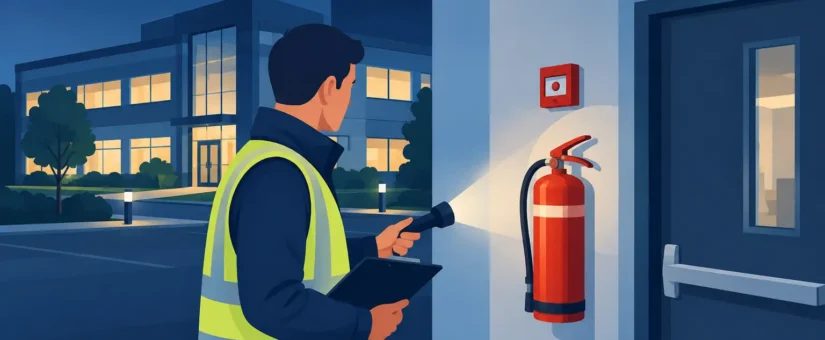
A fire risk assessment can be difficult to arrange when a building is fully occupied from morning until evening. A care setting cannot simply close its doors, a busy office may have no spare meeting rooms, and visiting an HMO during the working day can mean repeatedly missing tenants. An out of hours fire risk assessment gives the responsible person a practical way to meet their duties without creating unnecessary disruption for occupants or operations.
The timing does not make the assessment less thorough. It should still be a competent, documented inspection that considers the people at risk, potential ignition sources, fire precautions, escape arrangements and the actions needed to reduce risk. What changes is the appointment window and, often, the opportunity to see how the premises operate under quieter or different conditions.
Why book an out of hours fire risk assessment?
For many dutyholders, flexibility is not a convenience. It is the difference between completing essential compliance work promptly and leaving it unresolved while diaries, tenant access and business commitments are negotiated.
Evening, early-morning or weekend appointments can be particularly suitable where access during normal hours would interrupt trading, teaching, clinical activity or residents’ routines. A facilities manager may need an inspection before staff arrive. A landlord may need to minimise disturbance in a tenant-occupied block. A place of worship may need an appointment outside services, community groups and events.
Out-of-hours access can also help where a report is urgently required for a property transaction, lender query, insurer request or enforcement-related concern. It is not a shortcut through the legal process, and it cannot turn an unsafe building into a compliant one overnight. It can, however, allow the inspection and formal reporting process to start without waiting weeks for a suitable daytime slot.
Under the Regulatory Reform (Fire Safety) Order 2005, the responsible person must take general fire precautions and must record significant findings where required. The practical challenge is arranging a meaningful inspection while maintaining safe, workable premises. A flexible appointment helps address that challenge, but the quality of the assessment, evidence and subsequent action plan remains the priority.
What a competent assessment should cover
A proper fire risk assessment is more than a walk-through with a checklist. Using a recognised methodology such as PAS 79, an assessor should examine how fire could start, how it might spread, who could be affected and whether existing controls are suitable.
This normally includes the condition and management of escape routes, fire doors, emergency lighting, fire alarm arrangements, extinguishers where provided, signage, electrical and smoking controls, housekeeping, storage, evacuation procedures and staff training. The assessment must also account for people who may be especially vulnerable, including sleeping residents, children, older people, disabled occupants, lone workers and visitors unfamiliar with the building.
The right scope depends on the premises. A small office with a straightforward layout presents different risks from a mixed-use building, a shared house, a school, a healthcare environment or a block with common parts. In residential settings, the assessment must be clear about which areas and duties are within scope. Responsible persons should not assume that a generic report will satisfy every building type or legal requirement.
A detailed report should set out significant findings in plain terms, identify deficiencies, assign priorities and provide actionable recommendations. That documentation is often needed by insurers, managing agents, legal conveyancers and lenders, but its primary purpose is to support safer decisions and demonstrable compliance.
Timing can reveal operational risks
An evening inspection may reveal conditions that are not visible at 10am. For example, a premises may rely on a closing routine that leaves stock in corridors, a reception area may be unattended after a certain time, or a different group of occupants may use the building overnight. Conversely, some checks require access to plant rooms, offices or management records that are only available during the day.
This is why the appointment should be planned rather than simply booked at the latest available time. Tell the assessor how the building is used across a typical week, whether anyone sleeps on site, who will provide access and whether security systems or keyholders are involved. If daytime follow-up evidence is needed, it is better to agree this early than discover it after the visit.
Preparing premises for an evening or weekend visit
Good preparation protects the value of the appointment. The assessor needs safe access to the areas included within the agreed scope, including common parts, circulation routes, risers, plant areas and external escape routes where relevant. If parts of the building are locked, ensure that a competent keyholder is available or that access arrangements have been agreed in advance.
Provide current fire safety documents where available. These may include previous fire risk assessments, action plans, maintenance records, alarm and emergency-lighting test logs, evacuation information, fire door inspection records and plans. Missing documentation is not necessarily proof that a safety measure is absent, but it can make compliance harder to demonstrate and may need to be recorded as a management issue.
It also helps to advise staff, residents or security teams that an assessor will be attending. They do not need to change their normal behaviour or tidy away evidence of everyday use. The purpose is to understand the premises as they are managed in practice. However, clear communication avoids concern about an unfamiliar visitor and prevents avoidable delays at the door.
For a tenant-occupied property, access must be handled sensitively. Give reasonable notice, respect privacy and avoid assuming that every room can be entered at short notice. Where full access cannot be achieved, the limitation should be documented, alongside any further inspection required. A report is only as reliable as the areas and information available to the assessor.
Urgent does not mean incomplete
An urgent requirement often comes with pressure: completion is approaching, a policy renewal is due, or an agent has raised a query. In that situation, it is tempting to seek the fastest possible certificate. Fire risk assessments do not work that way. There is no universal pass certificate, and a responsible assessor should not offer one without understanding the building and recording their findings.
A rapid appointment can still deliver a careful inspection and an exhaustive digital report, provided the scope is clear and access is properly arranged. The report should distinguish between immediate life-safety concerns and improvements that need planned management. If a serious issue is found – such as a blocked escape route, defective fire door, inadequate alarm provision or an unsafe evacuation arrangement – the responsible person may need to act immediately rather than wait for a final formatted report.
Some recommendations require specialist input or practical works. A fire risk assessment may identify a need to review alarm coverage, improve emergency lighting, repair fire doors, update evacuation procedures or introduce better routine checks. The assessment identifies risk and proportionate action; it should not oversell unnecessary work. Clear advice, costs and timescales allow dutyholders to prioritise properly.
Choosing an assessor for flexible appointments
Availability matters, especially when a deadline is fixed, but it should not be the only selection criterion. Ask how the assessment will be carried out, what methodology will inform the report, whether the assessor is insured and what documentation you will receive. You should also establish the likely reporting timescale and whether support is available if an insurer, lender or enforcement authority asks for clarification.
Look for a service that treats out-of-hours work as a planned professional appointment, not an abbreviated visit. The assessor should be prepared to discuss site-specific risks, limitations on access and the information needed before arrival. Digital file access is particularly useful where several people need the report, such as a freeholder, managing agent, facilities team and legal representative.
For premises across London and the South East, flexible scheduling can make it easier to arrange inspections around commuting patterns, commercial opening hours and occupied properties. The same principle applies anywhere: the assessment should fit the operational reality of the building without compromising its depth.
Make the appointment work for the building
An out-of-hours inspection is most effective when it is treated as part of a wider fire-safety management process. Keep the report accessible, assign each action to a named person, retain evidence of completed works and review the assessment whenever the building, its occupancy or its use changes. Regular review also matters after a fire, a significant near miss, major alterations or changes to vulnerable occupants.
If normal working hours are the obstacle, do not let scheduling become the reason a necessary assessment is delayed. A well-planned out-of-hours appointment can provide the evidence, clarity and practical next steps needed to protect occupants and show that fire-safety responsibilities are being taken seriously.


0 Comments